

I’ve mowed everything from tiny yards to massive fields. Stand-ons outperform zero-turns on hills due to their low center of gravity and quick weight shifting. Zero-turns excel in wide-open spaces with decks up to 72 inches. Stand-ons navigate through gates and clutter easily; I’ve fit three where two zero-turns would struggle.
Zero-turns are faster, but stand-ons often complete jobs more quickly in areas with obstacles. Standing provides better support for my back on rough terrain, a fact I previously underestimated. Trailer space is also a consideration; stand-ons take up less room than zero-turns. Price tags can be misleading; durability and suitability are what determine real value, and I have made the wrong choice in the past. Each difference has more depth than one might expect.
Stand-On vs. Zero-Turn: Which Fits Your Property?
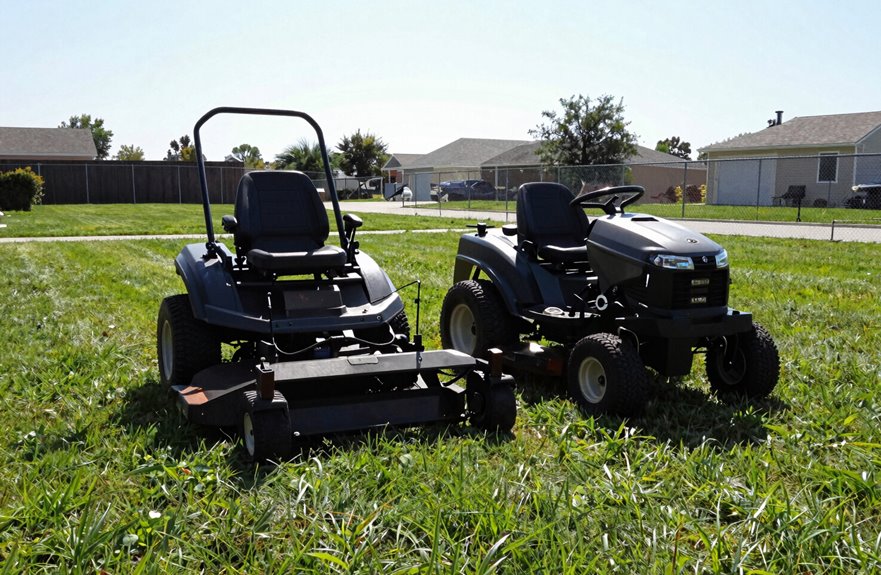
Why does picking the right mower feel harder than choosing a car sometimes? I’ve stared at specs until my eyes crossed.
Your property size and terrain tell the whole story. I have a compact stand-on mower for my obstacle-filled half-acre. The maneuverability helps around trees and flower beds. I can hop off in seconds to move toys or branches.
Zero-turn mowers excel on wide-open spaces. My neighbor’s 54-inch deck efficiently handles his three-acre field. However, I’ve seen him struggle in tight corners where my stand-on performs better.
Terrain also plays a significant role. Flat expanses benefit from zero-turn speed, while my bumpy, cluttered yard allows the stand-on’s visibility to help spot problems before encountering them. It’s essential to match your mower to your actual landscape rather than an idealized version.

This replacement belt for 041-6400-00 is 66.5 in long and 0.50 in wide, driving the hydro pumps on Bad Boy zero-turns.
Elevates your push mower for easy cleaning and routine upkeep

5-Blade reel with a cutting width of 16” and durable 10” polymer wheels for maximum maneuverability
Hills and Slopes: Which Mower Handles Steep Terrain?

How steep is too steep? I’ve learned this the hard way. Stand-on mowers generally excel on hills due to their lower center of gravity. You can shift your weight easily and exit quickly. Zero-turn mowers, however, struggle on inclines exceeding 10 to 15 degrees. I’ve seen them slide on wet grass, which can be dangerous.
| Terrain Type | Stand-On Mowers | Zero-Turn Mowers |
|---|---|---|
| Moderate slopes | Excellent stability, easy weight shifts | Manageable with caution |
| Steep hills | Safer exit, better control | Traction loss risk increases |
| Wet, uneven ground | Quick adjustments possible | Avoid; safety concerns rise |
Always check incline ratings, as every model differs. I once ignored specifications and regretted it. Slow down on slopes and avoid wet conditions. This approach will help protect both your equipment and your safety.

Compatible with OEM Part Numbers Hustler 784207

Compatible with OEM Part Numbers Exmark 103-3206, 103-8323

Replaces OEM Part: Husqvarna 539104335, 522795901
Maneuverability: Tight Spaces and Obstacle Navigation
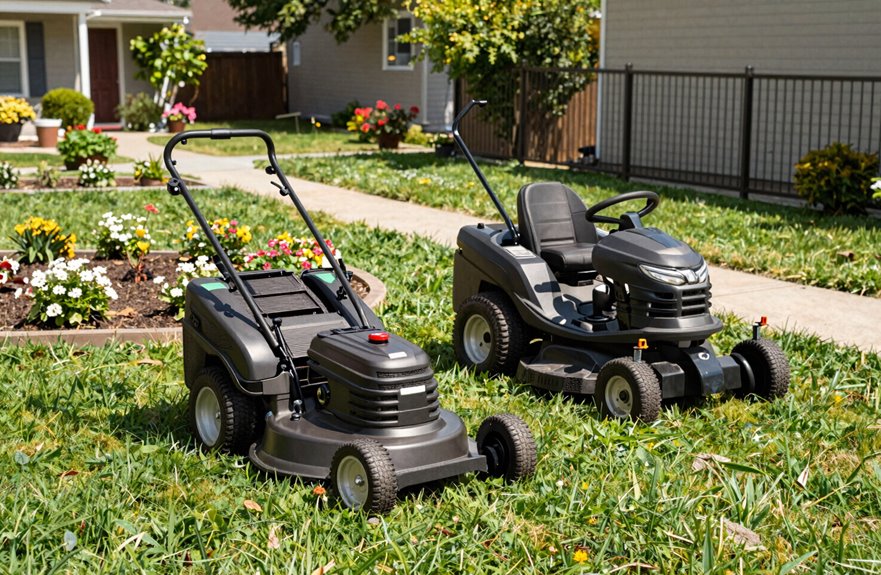
I’ve learned that squeezing through narrow gates and dodging trees isn’t just about horsepower; it’s about seeing what’s coming. Stand-on mowers put me closer to the ground, allowing me to spot roots and rocks before they cause damage. I can hop off quickly when a branch catches me off guard. Zero-turn mowers spin on a dime with their independent rear wheels, which can feel advantageous until you realize you’re sitting too high to notice a low-hanging limb until it’s too late.

Compatible with OEM Numbers Bad Boy 022-1000-00, 022-5234-98; Husqvarna 539001386, 539102643; Kubota K5371-42110; Toro 103-3168, 103-4051, 109-2098

Tire Parameter: Tire Size 13x6.50-6" nhs, Rim Diameter 6", Rim Width 4.5", Ply Rated 4PR, Tread Depth 4 mm, Speed Rating F, Max Load 460 lbs@28psi, Tire Weight 5.1 lbs, Tubeless

SPECIFICATIONS & LOAD CAPACITY - Size: 16x6.50-8 | Ply Rating: 4 PR | Max Load: 620 lbs | Type: Tubeless Tire & Wheel Assembly. Built with a durable steel rim and premium rubber compound, RUNIX tires provide dependable performance for residential and commercial lawn care.
Tight Cornering Capability
Where do you need to squeeze through? Not all mowers handle tight corners equally. A stand-on offers a compact footprint that navigates gaps that bulkier equipment cannot. I can quickly hop off if needed.
Zero-turn mowers pivot on their own axis with dual levers, allowing them to spin around trees effectively. The maneuverability can be impressive at times. My stand-on’s visibility helps me identify potential obstacles early, which is crucial to avoid damaging trees.
In wooded areas, my stand-on allows for quick exits, which can be advantageous. Zero-turns require more commitment in tight corners. Both types of mowers provide substantial capability, but your specific terrain and comfort with close-quarters cutting will determine which mower becomes your preferred choice.
Obstacle Visibility Advantage
Why does standing up matter so much when you’re threading between obstacles? It’s all about visibility. When I’m standing, I’ve got eye-line clearance over the deck. I spot rocks, roots, and flower bed edges before I hit them. Seated mowers hide ground-level hazards until it’s too late.
My compact footprint allows me to navigate around obstacles that would snag larger machines. I’ve learned obstacle detection the hard way, having scraped enough curbs to know better. The higher vantage point is essential for precise placement.
Additionally, quick off/on means I can clear branches or reassess tight spots without that awkward sit-stand dance. I’ve edged around obstacles I wouldn’t attempt while seated. Standing gives me the advantage.
Quick Egress Design
That visibility advantage pairs naturally with how fast I can bail out when things get dicey. I’ve learned the hard way that quick egress is essential when navigating tight spaces filled with obstacles.
My stand-on allows me to step off in a split second. No seat belts or armrests trapping me—just pure exitability when I spot debris or a hazard. I’m positioned right at the pivot point, so I can hop back on quickly and keep cutting.
The compact frame aids maneuverability. I can squeeze into spots where larger machines struggle, and my response remains sharp because I’m not dealing with a bulky seat. Safety involves not just avoiding accidents; it’s also about how quickly I can react when I make a mistake. I do, often.
Speed and Productivity: Which Mower Covers Ground Faster?
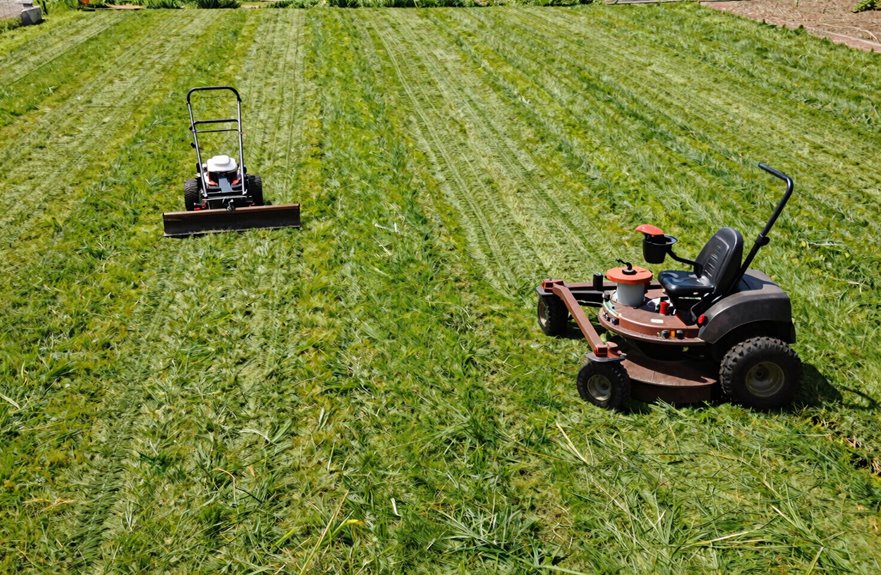
I’ve spent considerable time observing grass growth while testing these machines, and I’ve learned about speed. Zero-turn mowers excel on wide, open lawns; their 72-inch decks and 31-horsepower engines, like those in the Husqvarna Z572X, efficiently cover large areas. Stand-on mowers should not be overlooked, as their maneuverability in tight spaces often proves advantageous when navigating around trees and flower beds instead of just racing across open fields.
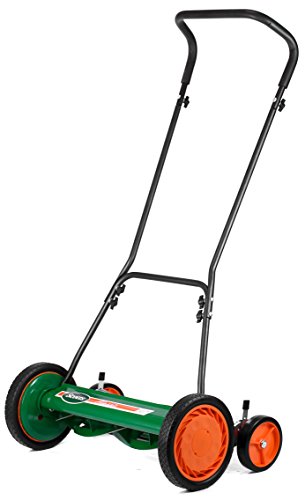
Classic Scotts 20 inch push no-motor manual reel rotary lawn mower features 20" cutting width, 5-blade ball bearing reel, and 10" dual tracking wheels

The Reel-Deal 5-Year Manufacturer Protection Plan: this comprehensive plan keeps your reel mower performing at its best season after season.
Ground Coverage Speed
Three factors usually decide which mower wins the race across your lawn: deck size, engine power, and how quickly you can dodge that forgotten garden gnome.
Zero-turn mowers dominate open fields. Their massive cutting decks, up to 72 inches, and powerful 31 hp engines, like those in the Z560X, provide exceptional ground coverage speed on flat expanses. The dual hydrostatic drives enhance their performance.
Stand-on mowers offer impressive maneuverability in tight spaces, where a bulky machine would take longer to navigate around trees and flower beds. In smaller, obstacle-heavy properties, compact stand-ons can outperform zero-turns because they require less time for reversing and more time for cutting.
Your productivity depends on matching the mower to your terrain.
Maneuver Efficiency Impact
Ground coverage speed tells only part of the story. Maneuverability shapes real productivity more than raw horsepower. Zero-turn mowers dominate open fields with their 31 HP engines and wide decks, yet they struggle in areas where agility is essential.
Stand-on mowers excel in accessing obstacles. You lean, pivot, and maintain momentum through tight spaces that can trap bulkier machines. I have struggled with edge clipping on zero-turns; stand-ons reward proper body positioning with superior edge efficiency.
- Your knees absorb bumps like shock absorbers on rough terrain.
- Decks hug flower beds without the need for multiple turns.
- Weight shifts guide you around playground equipment.
- Narrow gates become opportunities, not barriers.
- Stripes form seamlessly where larger mowers cannot go.
Evaluate your terrain, then choose the right equipment.
All-Day Comfort: Sitting vs. Standing Fatigue
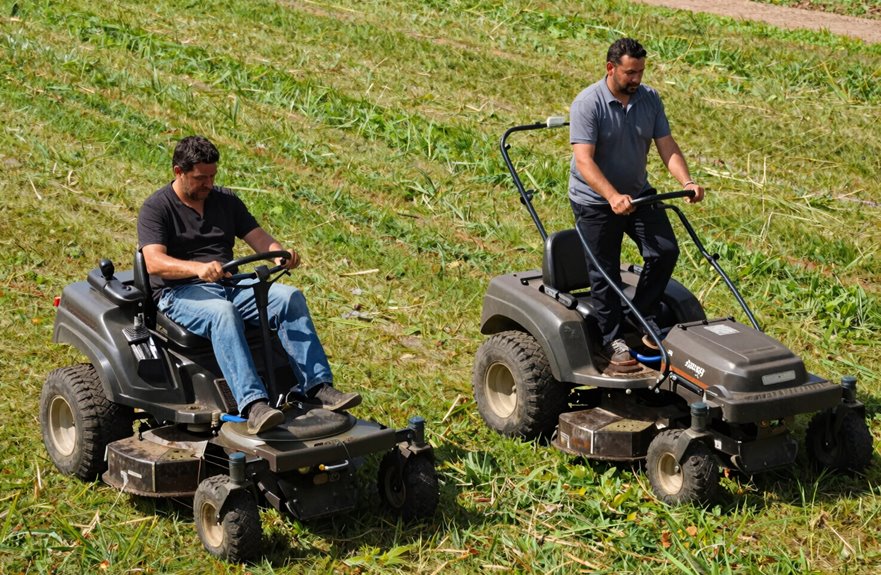
How do you stay comfortable when you’re mowing for eight hours straight? Operator comfort isn’t just about cushy seats.
Standing mowers changed my experience. They distribute shock through your feet and legs, which actually reduces back fatigue compared to sitting. I used to think sitting meant resting; continuous vibration and jolting on rough terrain ended up harming my posture anyway.
With stand-on setups, you maintain an upright position. You can shift your weight naturally and adjust quickly when you hit bumps. I’ve developed a knee-bend motion that helps protect my spine.
Premium seats do help dampen vibration. However, after eight hours, I find I am less fatigued standing than I was while sitting. Additionally, getting off the mower for obstacles keeps me active.

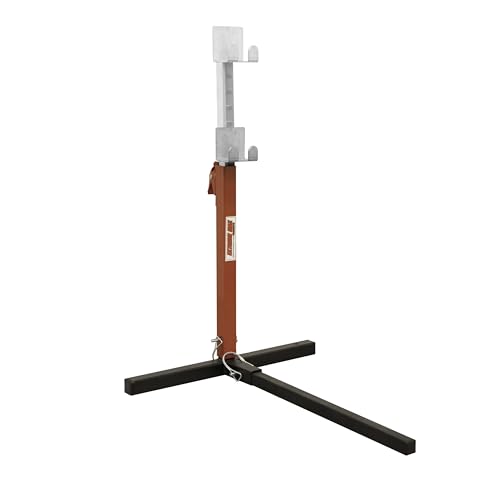
550 lb Heavy-Duty Mower Lift Jack: Solid steel frame supports up to 550 lbs for zero-turn mowers, riding mowers and lawn tractors—ideal shop/garage equipment for safe maintenance.

Includes grass catcher specially made for American Lawn Mower 18-Inch and 20-Inch (model 1815-18) reel lawn mowers to collect leaves and grasses.

Enhanced : Our Support Wheels for Trimmer facilitate height adjustments of your mower, reducing back pressure and ensuring a comfortable . Bid farewell to back discomfort and enjoy gardening with ease
Trailer Space and Storage: Which Mower Fits Your Setup?
Where does your mower sleep at night? I’ve learned that trailer space isn’t infinite, and my zero-turn mowers taught me that lesson with their 72-inch deck width and stretched-out frames. Stand-on mowers changed my game entirely.
Their compact design fits into corners I previously overlooked. I can fit three stand-ons where two zero-turns used to compete for space. Storage efficiency is crucial when hauling your entire operation.
- Your trailer packed tight like Tetris, every inch earning its keep.
- That satisfying clunk of a stand-on sliding into its slot.
- Zero-turns hanging off the ramp, highlighting measurement challenges.
- Extra room for blowers, trimmers, and maybe lunch.
- The pride of a clean, organized rig that attracts attention at the gas station.
Deck width decisions shape daily operations.

Replaces OEM: Toro, Exmark 135-5777, 109-9023, 135-5777-SL

【Compatible with Bad Boy Mowers】 Compatible with select Bad Boy zero-turn mowers including ZT Elite, Maverick, Maverick HD, Rebel, Rogue, Renegade, CZT, Outlaw, Outlaw Extreme, and Outlaw XP. Fits applicable 54", 60", 61", and 72" decks. Please verify your mower model and deck size before ordering

OE Part Number - 088-6003-00 ACS6000ULS, compatible with most Zero-Turn mowers (not suitable for Badboy mowers).Note:Please verify your mower model before purchase.
Price and Durability: Long-Term Value Compared
Why does my wallet still hurt years after buying my first zero-turn? I learned the hard way that sticker price barely scratches the surface of ownership costs.
Stand-on mowers deliver solid durability, lasting 1,500 to 3,000 hours when you stay on top of maintenance. Their compact footprint saves trailer space and storage fees, enhancing long-term value. Zero-turns like Husqvarna’s Z560X pack 31 horsepower and 72-inch decks, allowing for fast mowing over large areas. However, damaging that hydrostatic system can be costly. Matching your mower to your property is crucial, especially on rough terrain, which can wear down any machine. Generally, a higher upfront investment correlates with better durability and productivity. If you make the wrong choice, it will impact both your finances and your experience for years.

Compatible with OEM Numbers Ariens Gravely 21546197; Husqvarna Jonsered Poulan 174873, 532174873, 589527301

Compatible with OEM Part Numbers Exmark 109-2965

【Perfect Fit & Multipurpose】18x8.50-8 Lawn Mower Tire, 18x8.5-8 Tractor Lawn mower Tire, These 18x8.50-8 tires fit most zero-turn mowers, riding lawn mowers, golf carts, and garden utility vehicles (compatible with John Deere, Cub Cadet, Toro, etc.). Set of 2 ensures a balanced replacement.