
I’ve fixed my share of smoking mowers, and it usually comes down to three culprits: too much oil, a bad tilt, or the wrong viscosity. First, I check my dipstick; half a quart over the Full mark will burn white every time. If I tipped the deck past 15 degrees, oil leaked into places it shouldn’t be. I drain the excess, swap out a clogged air filter, and run it for five minutes to clear out. Sometimes I used 10W-30 when I needed straight 30W, which damaged my seals. If I see black smoke, that indicates a choked-up carb that needs attention. The fixes are simpler than you’d think, and I’ll walk you through each one so you know exactly what to do next time.
White vs. Black vs. Blue Smoke: What Each Color Reveals
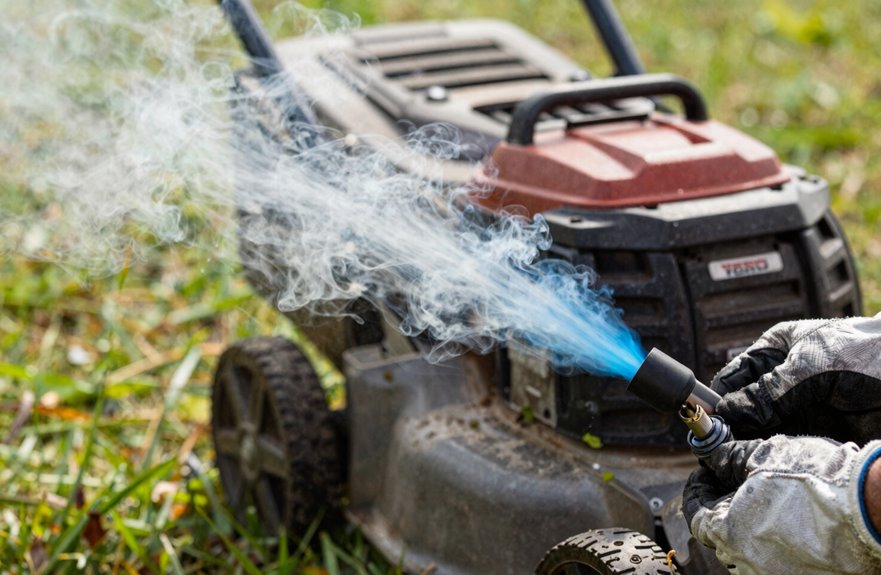
Why does my mower look like it’s trying to signal a rescue helicopter? I’ve been there, staring at that plume rising from my engine, wondering what went wrong this time.
Let’s crack the color code together. Blue, white, and black smoke indicate different issues, and I’ve learned to interpret them like warning flags. When I see white smoke, I’m usually dealing with oil somewhere it shouldn’t be; maybe I spilled some on a hot surface, or it’s sneaking into places it doesn’t belong. Blue smoke means oil is burning inside the engine itself, often from worn parts that should have been checked sooner. Black smoke indicates a fuel problem, such as a rich mixture or a clogged filter that is choking the air supply.
Each color points me toward a different fix, and I pay attention to them. You should too.
Why Too Much Oil Causes White Smoke (And How to Drain It)
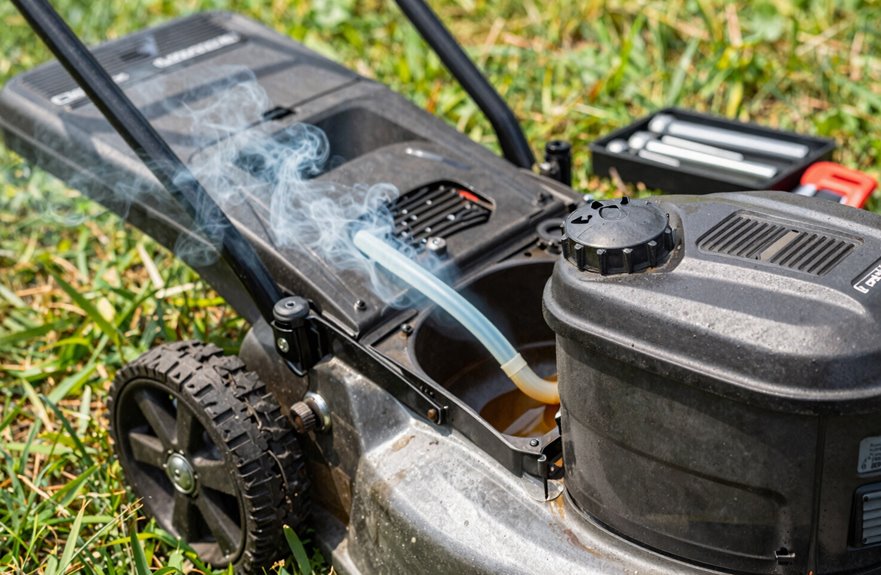
White smoke pouring from your mower? This often happens due to crankcase overfill. When the oil level exceeds the Full mark on the dipstick, the extra oil has nowhere to go. It can slosh onto hot engine parts or get sucked into the exhaust, resulting in white smoke.
Even half a quart too much can cause issues. The oil burns off, creating a thick, embarrassing cloud. To fix it, drain the excess oil until the dipstick reads correctly, wipe it clean, and check again. Keeping your oil level accurate will prevent issues while mowing.
Did You Tip Your Mower? How Angle Alone Creates Smoke
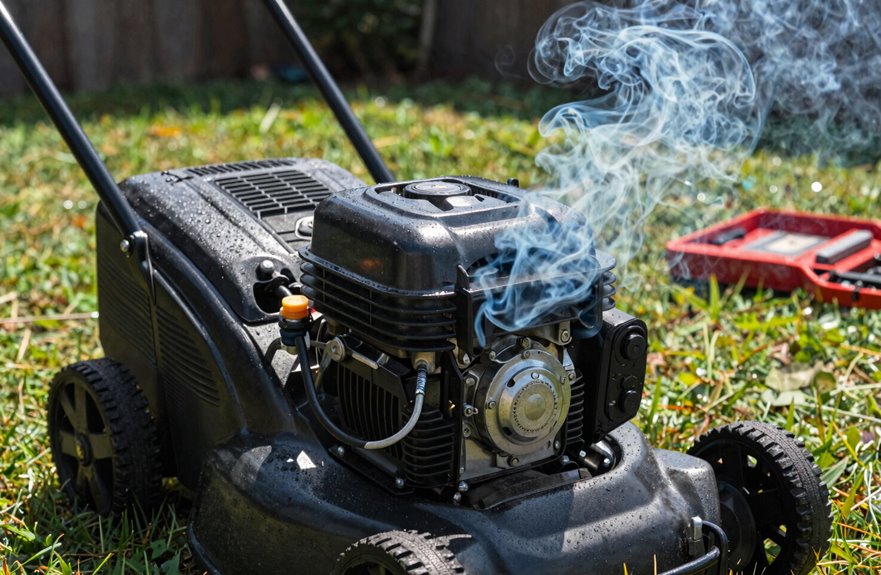
Sometimes you tilt your mower without thinking. I’ve done it too—flipped it over to sharpen blades or check underneath. Later, I wonder why smoke pours out. When you tilt beyond about 15 degrees, this happens:
- Oil sneaks into the combustion chamber and burns off as white smoke.
- The muffler gets coated with oil, creating an embarrassing cloud.
- Residual oil pushes into seals and breather lines.
- Oil pools in your carburetor or air filter.
Laying your mower on its side with the spark plug facing down can cause problems. Even brief tipping leads to issues. I keep mine flat now. Return it upright before starting, and let the oil burn off if you’ve already tipped it. This is a common experience.
Check Your Air Filter First: A 30-Second Diagnostic
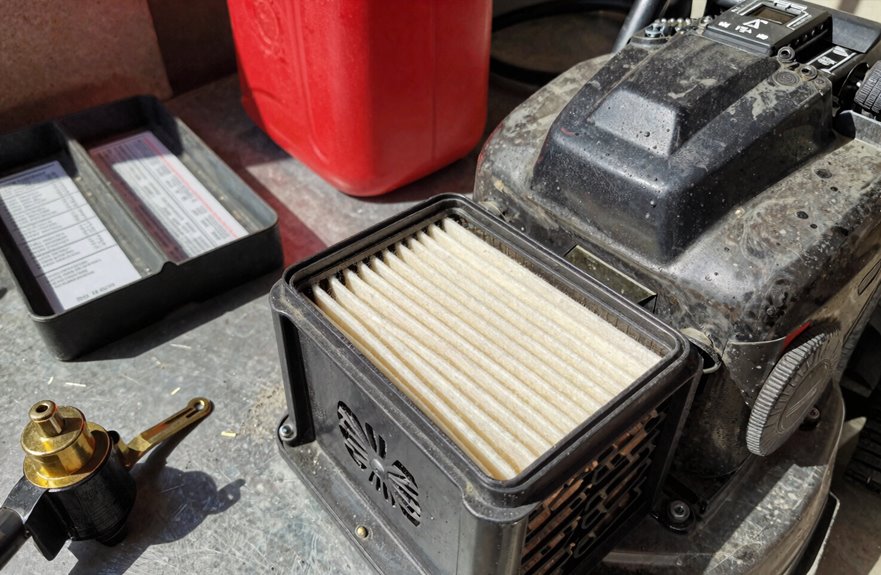
Where do I even start when smoke starts billowing? Panicking gets you nowhere. Grab your air filter first; it’s the quickest diagnostic tool available.
Pop off that cover and look closely. Is it clogged with grass clippings? Saturated with oil? A dirty filter chokes airflow, causing your engine to run rich and emit white smoke like a tiny chimney. I’ve pulled filters so dirty I couldn’t believe the mower ran at all.
If it’s oil-laden, that’s likely the issue. Replace it with a fresh one, then run the engine for five to ten minutes to burn off any residue. If it’s still smoking, your air filter wasn’t the problem, and deeper diagnostics will be necessary. At least you ruled out the easy fix first.
Wrong Oil Viscosity: Why 10W-30 and 30W Aren’t Interchangeable
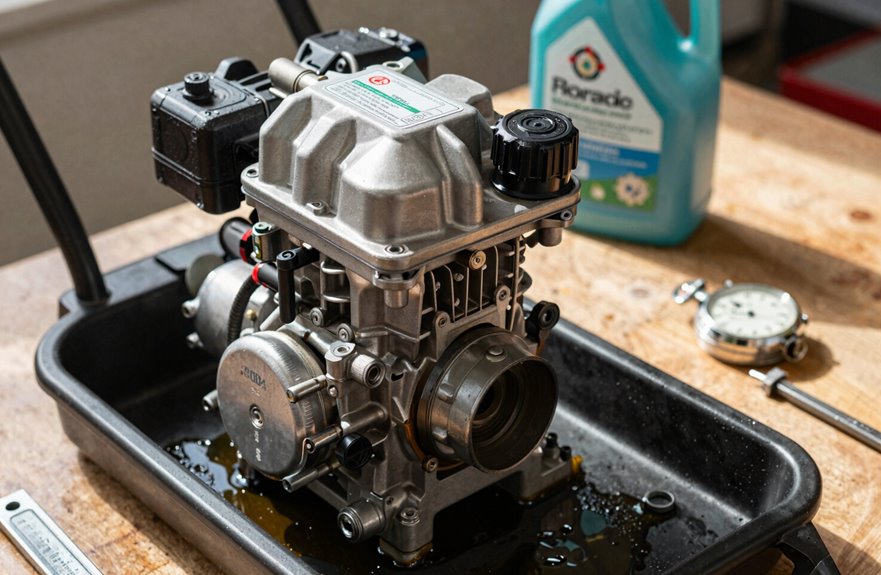
I learned the hard way that 10W-30 and straight 30W aren’t interchangeable. The “W” stands for winter, meaning 10W-30 flows like thin 10-weight oil when cold but thickens to 30-weight when hot; straight 30W remains thick at all temperatures. Your mower’s engine requires the specific oil type indicated by the manufacturer on the dipstick, especially when summer temperatures reach 90°F or winter mornings drop below 40°F.
Viscosity Grade Differences
Why does your mower smoke after an oil change? Oil grade is crucial for optimal performance.
Viscosity refers to how thick your oil flows. I once chose 10W-30 because it was on sale, which was a mistake since my mower required 30W.
Here’s what happens with a mismatch:
- 10W-30 acts thin when cold and thick when hot; 30W remains thick at all temperatures.
- The incorrect viscosity can damage seals, allowing oil to seep into combustion chambers.
- Cold-start protection is compromised with mismatched grades during winter mornings.
- High RPM lubrication is inadequate, leading to wear on rings and bearings over time.
I always check my manual before making a purchase. Using the correct viscosity grade is essential for your mower’s performance.
Seasonal Performance Impact
Temperature swings create real challenges for your mower’s oil performance. Oil viscosity is not just a number; it plays a crucial role in your engine’s seasonal operation. When I used 30W in November, my crankcase breather emitted white smoke like a tiny chimney.
| Season | Recommended Oil | Why It Matters |
|---|---|---|
| Cold starts (below 40°F) | 10W-30 | Flows fast, protects on startup |
| Hot summer (above 80°F) | 30W | Maintains film strength when thin |
| Mixed seasons | Check manual | Wrong weight burns, smokes, leaks |
| Extreme heat | 30W or 40W | Prevents breakdown, seal damage |
| Year-round mild | 10W-30 | Versatile, but verify specs |
Seasonal temperature changes impact your gaskets and breather seals, which expect specific oil thickness. Using winter oil in July can lead to leaks. Summer oil in March can cause hard starts and wear on your engine. I check my manual every spring to avoid a repeat of that white smoke incident.
When Smoke Means Internal Wear: Rings, Seals, and Breathers
I’ve learned the hard way that white smoke often indicates that my engine’s internal parts are wearing out, rather than just needing a quick fix. Worn piston rings or damaged valve seals allow oil to enter the combustion chamber, where it burns alongside fuel and produces that recognizable haze. A faulty crankcase breather can also trap pressure and oil, so I will guide you through identifying these issues before you replace parts unnecessarily.
Worn Piston Rings
A worn piston ring is one of those problems I’d rather not find, as the smoke often reveals the issue. When piston rings lose their seal, oil burning becomes the new normal. Ignoring the signs only worsens the situation.
You’re likely noticing:
- White or blue smoke that persists after startup
- Oil disappearing faster than expected
- Power loss that turns mowing into a workout
- Failed compression test readings below 90 PSI
The compression test reflects the reality—low numbers indicate that those rings aren’t functioning properly. Years of runtime, overheating, or the wrong oil viscosity can wear them down. Fixing it typically requires a rebuild. While it’s an inconvenient process, you’ll understand why your yard smells like a mechanic’s shop.
Damaged Valve Seals
Where does all that oil keep disappearing to when your valve seals start failing? It sneaks right past those worn seals and into your combustion chamber. I once wondered why my mower puffed blue smoke at startup like a tiny chimney; this is a classic symptom of failing valve seals.
The oil burning gets worse under load. Heat cycles make it unpredictable. Sometimes you’ll see white smoke, and other times that telltale blue haze. It’s important not to ignore these signs.
Diagnosing the issue involves running a compression test and checking every seal and gasket for leaks. This process can be tedious, but it is essential. Replacing valve seals isn’t glamorous, and you will likely need new hoses and gaskets as well. I once skipped replacing the breather hoses and regretted that decision. Completing the job thoroughly will eliminate that smoke.
Faulty Crankcase Breather
The crankcase breather is one of those parts you forget exists until it disrupts your day. I learned this the hard way. When your crankcase breather fails, oil vapor escapes where it shouldn’t, and suddenly your mower puffs white or blue smoke as if signaling for help.
Here’s what happens:
- The breather gets blocked or cracks, trapping pressure inside.
- That pressure finds weak spots—worn seals, aging rings—and pushes through.
- Oil sneaks past those seals straight into the combustion chamber.
- Your engine starts burning oil along with gas, creating that telltale smoke.
I check the breather tube first. Is it collapsed, clogged, or lacking vacuum flow? Replace it. Additionally, address the worn rings or seals, or you’ll soon face the same issue again.
Head Gasket Failure: The Smoke That Won’t Clear
Why does that smoke keep lingering like an uninvited guest? A blown head gasket allows oil or coolant to enter areas where they shouldn’t be, leading to your white smoke issue.
| What I See | What It Means | What I Do |
|---|---|---|
| White smoke billowing | Oil burning in combustion | Run a compression test |
| Oil weeping at seams | Gasket’s given up | Check cylinder pressure |
| Fouled plug, power drop | Compression’s escaping | Compare readings across cylinders |
My compression test once showed 90 PSI on one cylinder and 120 on another. This indicates a problem. Overheating or detonation usually causes this situation. You’ll need a new head gasket, possibly some machining, and definitely a thorough cleaning. It’s a significant repair, but you will understand why that smoke persists.
Quick Fixes That Actually Work in Under 10 Minutes
Sometimes I panic when I see smoke pouring from my mower, but not every problem requires a weekend in the garage. Quick fixes exist. I’ve done these myself.
Smoke from my mower used to send me into a panic—until I learned most fixes take minutes, not weekends.
- I shut off the engine immediately and let it cool, then check if the oil level is overfilled and drain to the correct level.
- I clean or replace the air filter and inspect the spark plug for oil fouling or buildup before reattempting to start it.
- I run the mower for 5–10 minutes after correcting the oil and filter to burn off any oil that entered the combustion chamber.
- If white smoke persists, I tilt the mower carefully with the spark plug facing up to prevent oil from draining into the carburetor during checks.
After these steps, I perform a brief compression check to ensure there’s no ongoing oil intrusion.
Step-by-Step: Burning Off Oil Without Damaging Your Engine
Once I’ve ruled out the quick fixes, I’m left with oil sitting where it shouldn’t be. I start the mower and let it run for 5–10 minutes, even if it’s smoking like a campfire. The oil needs time to burn off from the combustion chamber and exhaust path. I keep the speed steady and moderate; no revving as if I’m racing, because aggressive throttling stresses the seals. If I tipped the mower earlier, I tilt it back level, let it cool, then check the dipstick to ensure I’m in the add to full range. After cooling, I clean or replace the air filter since oil contamination there continues the smoking. If it’s still puffing after ten minutes, I stop and look for leaks or overfill rather than pushing my luck.
Black Smoke Fixes: Carburetor, Choke, and Fuel Mixture
When I see black smoke rolling out of my mower, I know I’ve got a fuel problem, not an oil problem. This indicates my engine is running too rich, essentially drowning in fuel while gasping for air. Here’s what I check:
- My air filter, which I’ve neglected for two seasons
- The choke, since I sometimes forget to push it back in after starting
- The carburetor, where gummy residue builds up like plaque in arteries
- Fuel mixture balance, as I once used old gas and experienced issues
I pop off the air filter first; if it’s gray and fuzzy, I swap it. Then I wiggle the choke to ensure it opens fully. If smoke persists, I rebuild the carburetor. It’s messy, but it resolves the problem.
Maintenance Habits That Prevent Future Smoke Issues
I check my oil every Saturday morning before I mow, keeping it right between those Add and Full marks to avoid that embarrassing white smoke cloud again. Swapping out the air filter at the start of each cutting season is essential; a clogged filter makes your engine work much harder. These two habits have significantly reduced my need for more “why is my lawn mower smoking” Google searches than I care to admit.
Weekly Oil Checks
The dipstick provides accurate information, and I’ve learned that through experience. Once a week, I check my oil level after the engine cools. I pull the dipstick, wipe it clean, and reinsert it. The oil should sit between Add and Full; overfilling causes white smoke, which is undesirable.
During my weekly routine, I:
- Verify the oil level sits exactly between the marks, never above Full
- Inspect for oil leaks around the engine block and drain plug
- Check that oil hasn’t migrated toward the crankcase breather if I’ve tilted the mower
- Record my findings in a notebook to spot trends before smoke appears
I use SAE 30, the manufacturer-recommended viscosity, and I never mix brands. I clean spills immediately, as burning oil produces an unpleasant smell and causes smoke. These five minutes help prevent future issues.
Seasonal Filter Changes
A clogged air filter taught me my most expensive lesson yet. I ignored mine for two seasons. Oil soaked through. The engine choked. White smoke poured out like I had invented a fog machine. I won’t make that mistake again.
Seasonal maintenance is essential; it ensures our mowers start reliably. I swap my air filter every spring now. It takes five minutes and costs eight dollars. I also check oil levels mid-season because overfilling can cause the same white smoke issue. I learned that the hard way too.
I clean the spark plug, scrape the deck, and document everything on a fridge calendar. My mower responds with clean starts and no smoke. You’ll notice the improvement immediately.
Should You Repair or Replace? Cost-Benefit Reality Check
When your mower starts smoking like it’s trying to signal the neighbors, you’ve got a choice to make. I’ve stood in my yard, oil-stained and confused, wondering if I’m throwing good money after bad. The repair vs. replace debate is important.
Here’s my cost-benefit breakdown:
- Overfill oil fix: Drain and refill correctly—maybe $15 and twenty minutes of your life
- Simple fixes (air filter, carburetor): $20–$80 beats a $400+ replacement every time
- Major engine work (head gasket, piston rings): Often pushes past $300, and that’s when I start sweating
- Old mowers with multiple failures: Replacement wins; I’ve learned this the hard way
Get a proper diagnostic first. This approach helps you avoid becoming the neighbor with a permanently smoking yard ornament.
Electric and Robotic Alternatives: Bypassing Oil Problems Entirely
Sometimes I question why I spent years dealing with oil changes and engine smoke when I could have simply plugged something in. Electric mowers transformed my experience. There’s no need to check dipsticks or wonder about the source of that garage fire smell.
| Feature | Benefit |
|---|---|
| Battery-powered motors | Zero oil changes ever |
| LiDAR/vision AI navigation | Autonomous, hands-free mowing |
| Drop & Go L-SLAM mapping | No boundary wires to install |
| Intelligent path planning | Striped finish without engine smoke |
These oil-free alternatives completely eliminate head-gasket failures. I have reduced my maintenance time by hours each season. The Sunseeker Elite X4 effectively manages slopes and edges without producing any smoke. Transitioning to electric offers a solution for those seeking to avoid mechanical issues.